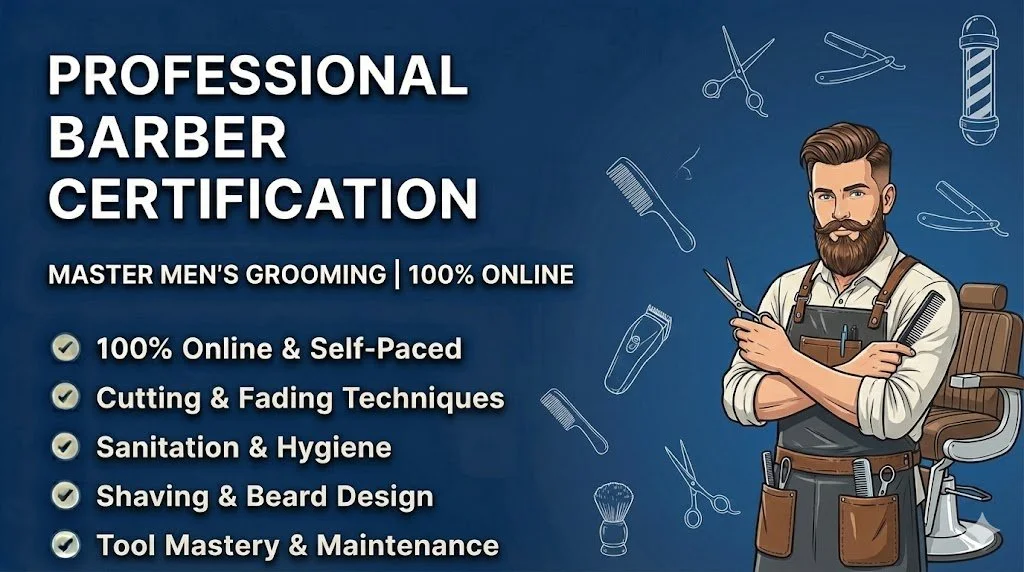
Train for a barbering career: fades, lineups, beards, and shop skills
Step into the craft of modern barbering with a comprehensive, written training program you can complete entirely online, at your own pace. The Barber Certification Course takes you from the foundations of scope, sanitation, and tool control all the way through fades, lineups, beard work, and shop business skills. It is built for aspiring barbers, cosmetologists broadening their skillset, and dedicated grooming enthusiasts who want a structured, professional grounding in barbering technique and theory.
This is Expert Skills' own foundational, knowledge-first barbering certification course, it explains how and why barbering works, lesson by lesson. What it gives you is a confident, well-rounded understanding of the craft and an Expert Skills certification you can be proud of.
Through 12 comprehensive modules and dozens of focused lessons, you'll build a complete picture of professional barbering:
This course is accredited by Expert Skills and recognized internationally for professional development. On passing the final exam, you'll earn your Expert Skills certificate of completion. You can also order a personalized hard-copy certification, an optional paid upgrade printed with your name and the course title. Order your official certification here.
You get two full months of access to study at your own pace, on any device. Need more time? Access can be extended on the site for a small fee, so you can revisit techniques whenever you like.
The techniques and theory in this course apply across barbershops, grooming lounges, men's salons, and mobile and suite-based settings. It's a strong foundation whether you're preparing to pursue formal licensure, expanding the services you already offer, or building deeper expertise in cutting and grooming.
Build your barbering knowledge from the ground up. Enroll today, start your journey into the craft, and join thousands of Expert Skills learners advancing their skills online.
Below is the beginning of the first lesson. Enroll to access all 96 lessons.
Yes. It is accredited by Expert Skills, registered under the UK Government's UK Register of Learning Providers (UKRLP / UKPRN 10092631), and recognized internationally for professional development.
No prior experience is required. The course begins with the fundamentals and builds step by step, so complete beginners and working professionals can both follow along.
You get two months of full access. If you need longer, you can extend your access on the site for a small fee.
Yes. The course is fully online and works on your phone, tablet, or computer, so you can learn wherever you are.
Issued under our UKRLP registration (UKPRN 10092631). Recognized in the United States and United Kingdom.
 UKPRN 10092631
Enroll today, get instant access.
Enroll to continue reading
Get instant access to all 96 lessons.